SkyCandy - Sunset Forecast App
- 3.2
- Rating
- 10.00K
- Installs
- Free
- Price

 Analysis by App-foxy
I downloaded SkyCandy because ordinary weather apps rarely answer the question I actually have before going outside: will the sky be worth watching? Most forecasts focus on temperature, rain, wind, and alerts. This app takes a narrower, more visual approach, helping people look for colorful sunrise and sunset conditions. After spending time with it, I see the appeal immediately, but I also think its lasting value depends heavily on your habits and location.
SkyCandy is a free weather app from Dunbar Technology, LLC, with an Everyone age rating. Its purpose is not to replace a full daily forecast. Instead, it works as a companion for anyone who enjoys photography, walks, scenic drives, outdoor meals, or simply catching a memorable sky at the right moment. Its best quality is focus: it turns a vague hope for a dramatic sunset into something you can check before making plans.
From first-week excitement to a useful sky-watching habit
During the first week, the app feels more interesting than a standard forecast because it encourages a different way of reading the day. Rather than opening a weather screen only when I need to know whether to carry an umbrella, I found myself checking it when I wanted to decide whether it was worth heading to a nearby viewpoint. That small change makes the experience feel more personal and less routine.
You May Also Like

 Blood Strike: 2.5 Anniversary
Blood Strike’s Loadouts Turn Every Drop Into a Tactical Gamble
A close look at Blood Strike’s custom loadouts: how fast access to signature weapons reshapes its battle royale rhythm, rewards preparation, and narrows the gap between fights.

 Pandora - Music & Podcasts
Pandora’s Music Is Easy to Start, but Harder to Recover
Pandora’s strength is its low-effort path from a seed to a station. Its weak spot is how much confidence it asks you to place in connection, setup, and quiet recovery.

 8 Ball Pool
 Is Built on Rivalries, Rematches, and Routine
A close look at the rivalries, rematches, shared routines, and unanswered safety questions that turn a quick pool match into a persistent mobile community.

 Samsung Music
’s Quiet Strength Is Playing What You Already Own
Its reach comes less from spectacle than from dependable access to a personal library. That simplicity is both the app’s strongest retention engine and its ceiling.

 AccuWeather: Weather Radar
AccuWeather Review: A Quick, Clear Forecast for Everyday Decisions
For everyday plans, the best forecast is the one you can understand quickly. AccuWeather makes rain timing, radar, and local conditions easy to act on, with a few trade-offs.

 Hill Climb Racing
Why Hill Climb Racing Still Turns Crashes Into One More Run
A tiny car, a bumpy hill and one more upgrade: Hill Climb Racing keeps resurfacing because its simple chaos makes every near-miss feel personal.
More From Our News Desk
View All News


The store summary describes SkyCandy as a sunrise and sunset forecast app for finding vivid, colorful skies. That is a concise description of the idea, but the practical benefit is broader. It gives a sky-focused reason to pay attention to weather patterns that might otherwise seem unimportant. A partly cloudy evening, for example, may be more interesting to a photographer than a completely clear one, while a gray, low-cloud day may not justify a special trip.
I would not install it expecting the broad information found in a conventional weather service. A general weather app remains the better choice for hourly temperatures, severe-weather planning, commuting, or checking conditions for a long journey. SkyCandy makes more sense beside that kind of app, not necessarily in place of it. The distinction matters because its value comes from helping with a specific decision rather than attempting to cover every weather need.
The first-week appeal is strongest for people who already notice light. If you regularly take pictures with your phone, enjoy early walks, or plan outdoor moments around golden-hour scenery, the app gives those interests a practical starting point. It can also help families decide whether an evening picnic might have a more attractive backdrop, or help someone choose between staying home and taking a short drive to watch the horizon.
How I would use it before a real outing
My preferred workflow is simple. I would check the app earlier in the day, note whether the evening looks promising, and then check again before leaving. That prevents a common mistake: treating a colorful-sky forecast as a guarantee. Atmospheric conditions can change, and the view from one location may be very different from another because of buildings, trees, hills, haze, or nearby cloud cover.
For a photographer, the useful decision is not just “sunset or no sunset.” It is whether the expected conditions justify preparing a tripod, charging a phone, choosing a lens, or walking to a better viewpoint. SkyCandy can support that decision, but I would still use a regular weather app for wind, rain, visibility, and temperature. The focused forecast tells me whether the light may be interesting; the broader forecast tells me whether being outside will be comfortable and sensible.
A realistic everyday example would be a weekday evening when I finish work and have only a short window before dinner. I could glance at SkyCandy, see that the evening may be worth watching, and choose a nearby open area instead of making a longer trip. If the conditions look unpromising, I save the time and avoid building an elaborate plan around a sunset that may disappoint. That is a modest benefit, but it is exactly the kind of small decision an app like this can improve.
What makes the concept different from ordinary weather apps
Most weather apps are built around urgency and utility. They tell me whether I need a coat, whether rain may interrupt a trip, or whether conditions could become dangerous. SkyCandy is more about anticipation. It encourages me to look for a pleasant event rather than merely avoid an unpleasant one. That emotional difference is why the app can feel refreshing during the first few days.
It also has a natural advantage over manually checking a general forecast and trying to interpret cloud cover myself. I can certainly open a standard weather service, look at the hourly forecast, and make an educated guess about the sky. SkyCandy reduces that mental work by presenting the experience around sunrise and sunset. For a casual user, that focus is more approachable than translating several separate weather indicators into a prediction about color.
The trade-off is depth. Someone who wants radar, detailed wind information, air-quality readings, storm notifications, or extensive historical weather tools will probably prefer a larger weather platform. SkyCandy is not compelling because it has more information; it is compelling because it frames a small part of the forecast in a more enjoyable way.
Where the first-week novelty starts to fade
The initial excitement can fade if every check leads to the same action: look at the forecast and do nothing. Sunrise requires an early commitment, and sunset can be blocked by work, school, family responsibilities, or poor access to an open horizon. Even a good prediction is not automatically useful if I cannot reach a suitable place at the right time.
That is the first important limitation. The app can help me identify an opportunity, but it cannot create the time or location needed to enjoy it. People living among tall buildings, dense trees, or frequent haze may find the visual promise less rewarding than someone with a broad view. The experience is therefore closely tied to geography and routine, not only to the app itself.
I also think expectations need managing. A forecast for vivid conditions should be treated as an invitation to look, not a promise of a spectacular photograph. The final result depends on the angle of view, local obstructions, the timing of the light, and what the camera does with the scene. If I open the app expecting every recommended moment to look dramatic, disappointment will arrive quickly.
Month-to-month value, upkeep, and the reasons users may tire of it
After the first month, SkyCandy has to earn its place through repeated usefulness rather than curiosity. I would keep it installed if it helped me make a recurring habit out of short outdoor breaks. The strongest long-term pattern would be checking it before weekends, planning occasional photography walks, or using it as a prompt to step outside after spending too much time indoors.
That recurring value is real, but it is narrower than the value of a daily weather app. I may open a general forecast several times in one day because it affects practical decisions. SkyCandy is more likely to be opened when I am already interested in the sky. If that interest is occasional, the app may become something I remember only when a beautiful sunset happens by chance.
One way to make it more durable is to connect it to an existing routine instead of creating a completely new one. I could check it while planning a weekend walk, before deciding where to meet a friend, or when organizing a casual photo session. This is better than promising myself that I will wake up early every morning just to inspect the sunrise forecast. A habit that fits naturally into plans is more likely to survive the novelty period.
Another useful approach is to treat the app as a planning filter. I would not ask it to decide whether the entire day is worth going outside. I would use it to choose between two already reasonable options: a nearby park or an indoor café with a view, an ordinary walk or a route with a western horizon, a quick phone snapshot or a more deliberate photography outing. That keeps the app’s role realistic and reduces the feeling that it must deliver a major event every time.
How much maintenance does it require?
SkyCandy is not the kind of app that demands constant organization. There is no reason to build a large library of content around it or spend time configuring complicated workflows. Its maintenance burden is mainly behavioral: remembering to open it at a useful time and interpreting the forecast with common sense.
That low effort is a strength, especially for people who dislike overbuilt weather applications. I do not want to spend several minutes navigating through charts when I only need a quick sense of whether tonight’s sky might be interesting. A focused tool can be more pleasant precisely because it asks less of me.
At the same time, low maintenance can become low engagement. If the app does not become part of a real routine, there may be little reason to return. I would recommend placing it alongside the weather tools I already use, rather than expecting it to become my only source of outdoor information. The app works best as a lightweight layer on top of existing planning habits.
Its current version is 2.8.0, and the app supports devices running Android 7.0 or later. That makes it accessible to people using older compatible phones, although the practical experience will still depend on the device and operating system environment. The developer is Dunbar Technology, LLC, and the app has reached over ten thousand installs. Those details suggest a focused product with a modest audience rather than a mainstream weather platform.
Where the cost question enters the experience
The app is free to install, which makes trying the concept easy. However, in-app purchases range from $0.99 to $99.99 per item. That wide range means I would pay close attention to what is included before buying anything. A free download lowers the barrier to experimentation, but it does not automatically mean every useful part of the experience is available without spending.
For casual users, the free experience needs to be enough to establish whether the app fits their routine. I would use it for several real planning situations before considering a purchase: a weekday evening, a weekend walk, and a sunrise or sunset that I can realistically reach. If it does not improve those moments, paying for additional access would not solve the underlying problem of limited time or poor viewing conditions.
For dedicated photographers or sky enthusiasts, a purchase may feel more reasonable if it supports a workflow they use repeatedly. Even then, I would judge it by the frequency of actual outings, not by the excitement of seeing an attractive forecast. A tool used once every few weeks should be evaluated differently from one checked almost daily.
The main sources of fatigue
The first source of fatigue is repetition. Sunrises and sunsets happen every day, but not every day feels meaningfully different from the last. If the app presents a promising possibility too often, the alerts or forecasts may lose their urgency. If it is too conservative, I may miss moments that would have been worth seeing. Either way, the user has to accept that the value is probabilistic.
The second source is logistics. A good forecast may arrive at an inconvenient time, and the best viewing location may be farther away than the available window allows. This is especially relevant for sunrise, when preparation and travel happen before most daily responsibilities begin. The app can make the opportunity visible, but it cannot remove the effort required to act on it.
The third is comparison with specialized alternatives. A photography enthusiast may eventually want tools that help with composition, camera planning, or detailed location preparation. A person who mainly wants reliable weather safety information will likely be happier with a conventional forecast service. SkyCandy occupies a pleasant middle ground, but that also means it may be outgrown by users with more demanding needs.
The average rating is 3.2 from around five hundred ratings, alongside more than one hundred written reviews. I read that as a reason to approach the app with measured expectations rather than assuming it will suit everyone. A focused weather idea can be delightful for the right person and unnecessary for someone who wants a complete forecast dashboard. The rating makes sense in that context: usefulness is likely to depend strongly on personal interest and circumstances.
Who should install it, and who should skip it?
I would recommend SkyCandy to someone who already enjoys photographing the sky, plans outdoor leisure around light, or wants a gentle prompt to take short walks. It is also a good fit for people who find standard weather apps too functional and want a more visual reason to check the forecast. The free entry point makes it easy to test without committing to a subscription-style habit.
I would skip it if my main concern is rain timing, storm safety, commuting conditions, or detailed hourly planning. I would also skip it if I rarely have access to an open horizon or cannot adjust my schedule around sunrise and sunset. In those cases, a conventional weather app will provide more practical value, and SkyCandy may simply become another unused icon.
For families, the app could be a useful planning aid for occasional outdoor activities, but I would not build an important event around its prediction alone. I would combine it with a broader forecast and a backup plan. For serious photographers, it can be a helpful first filter, though not necessarily a complete planning system. That distinction prevents the app from being judged unfairly for not doing a larger weather app’s job.
My long-term verdict
SkyCandy earns lasting space on my phone only when I treat it as a small inspiration tool rather than a complete weather service. Its core idea remains appealing after the first week because it answers a different question from most forecast apps: is there a reason to look toward the horizon today? That is a worthwhile question, especially for people who enjoy visual moments and can act on them.
Its weaknesses are equally clear. The experience depends on location, free time, expectations, and a willingness to check repeatedly for an event that may still look ordinary in person. The broad in-app purchase range also means I would test the free version carefully before spending. None of these issues makes the app poor, but they limit its audience and make long-term value personal rather than universal.
My recommendation is to install it if you want a focused companion for sunrise and sunset planning, then judge it by whether it changes your behavior in a useful way. If it helps you take a walk, choose a better viewpoint, or make time for a few memorable photographs, it has earned its place. If you only open it out of curiosity and never use the forecast to make a real plan, the novelty will probably fade.
In my experience, SkyCandy is most successful as a quiet nudge toward looking up, not as a replacement for the weather app you already trust. That makes it a worthwhile free experiment for sky watchers, photographers, and anyone who values small outdoor rituals, while practical weather users and people with little flexibility will likely get more from a broader alternative.
FAQs for SkyCandy - Sunset Forecast App
01What is SkyCandy - Sunset Forecast App used for?
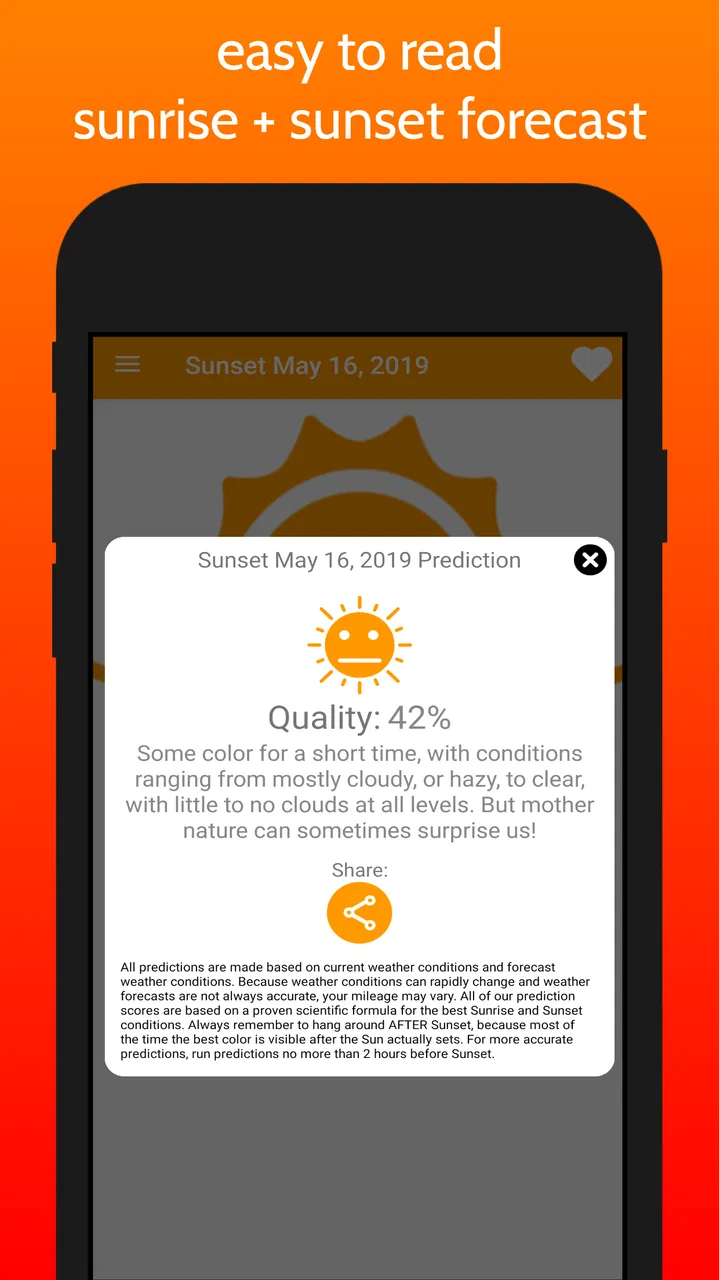
SkyCandy is designed to help users discover and plan for attractive sunset conditions. It presents sunset timing and forecast information in a simple, visual format, making it useful for photographers, travelers, outdoor enthusiasts, and anyone who enjoys watching the evening sky. Before relying on it, remember that sunset colors can change quickly because of local clouds, haze, visibility, and weather conditions.
02How accurate are SkyCandy’s sunset predictions?
The app can provide a helpful indication of when sunset will occur and whether conditions may be favorable for colorful skies, but no forecast can guarantee a spectacular sunset. SkyCandy’s results depend on weather data, forecast updates, and your location settings. During testing, users should treat its ratings or recommendations as guidance rather than certainty, especially in areas with rapidly changing weather or limited forecast coverage.
03Does SkyCandy require my location, and can I search other places?
SkyCandy may request location access so it can calculate local sunset times and display forecasts for your current area. You should review the permission request and choose the access level you are comfortable with, such as approximate or while-using access when available. Depending on the version, the app may also allow users to search or save other locations for trips and sunset planning.
04Does SkyCandy work without an internet connection?
SkyCandy generally needs an internet connection to retrieve updated weather information, forecast conditions, and location-based data. Basic information that has already loaded may remain visible temporarily, but offline availability should not be assumed. If you are heading to a remote viewpoint, open the app beforehand, check the forecast, confirm the sunset time, and keep a backup weather app or source available.
05Is SkyCandy free to download, and are there any in-app purchases?
The availability of free features, advertisements, subscriptions, or one-time purchases can vary by platform and app version, so users should check the Google Play Store or Apple App Store listing before downloading. Review the pricing details carefully, particularly if advanced forecasts, alerts, saved locations, or ad-free use are offered through a subscription. Store policies also determine cancellation and refund options.
Pros
- Shows sunset times with clear
- easy-to-read visual forecasts.
- Useful golden-hour details help plan photography and outdoor activities.
- Location-based forecasts make setup quick for most users.
- Colorful sunset previews make daily weather information more engaging.
- Simple interface is approachable for casual users and photography fans.
Cons
- Forecast accuracy depends on location data and changing weather conditions.
- Some features or forecast details may require a paid upgrade.
- Limited usefulness in areas with frequent cloud cover or poor visibility.
- Sunset information may be less valuable for users who rarely plan outdoors.
- Background location access can raise privacy concerns for some users.

SkyCandy - Sunset Forecast App
Gallery